
by Rebecca Laes-Kushner, David Aled Williams and Barret Mbuvi Kamunzu
Rebecca Laes-Kushner is an NGO consultant, providing research, data analysis, MEAL and training services to NGOs in developing countries.
David Aled Williams, PhD is a Principal Adviser at the U4 Anti-Corruption Resource Centre and a Senior Researcher at the Chr. Michelsen Institute in Norway.
Barret Kamunzu is a researcher and MEAL practitioner based in Kenya, supporting programs across East Africa, with extensive experience in donor-funded projects and refugee programs.
Part 1 of this series combines a brief introduction to corruption based on Aled’s research on corruption in climate change projects and Barret’s firsthand experience of program delivery and verification in Kenya with the results of Rebecca’s exploratory mini-survey of stakeholders in climate change projects who experienced one or more types of corruption. Part 2 covers experiences of corruption from Rebecca’s interviews with survey respondents and Barret’s personal experiences as a development professional.*
The accounts illustrate how corruption risks arise and how organizations might respond; they do not establish how widespread these practices are.
*Interviewees are identified by pseudonyms; the authors contribute under their own names.
This final part of the series provides guidance and inspiration for funders, donors, NGOs and governments involved in climate change projects who want to take concrete steps to reduce corruption in their projects. We look at several exemplary organizations and share lessons from both literature and the key informant interviews regarding potential solutions.
Organizations who employ robust systems to counter corruption
It is possible to develop structures and systems that reduce the potential for corruption. We want to highlight three organizations who exemplify efforts that both donors and NGOs need to undertake to minimize corruption. The following organizations offer examples of verification, risk management and public reporting that climate funders and implementers can learn from. Of course, any anti-corruption practices need to be adapted to local contexts and not considered proof of an organization being free of corruption.
GiveDirectly offers useful practices for checking that assistance reaches its intended recipients. According to its published procedures, it separates enrollment from independent checks, verifies recipient identities and follows up after payments to confirm that people received their money.
Significantly, GiveDirectly also publicly reports failures. In 2023, GiveDirectly disclosed that staff in the Democratic Republic of Congo had colluded with outsiders to divert recipients’ payments. It described the investigation, external reviews and changes to its controls.
Its 2025 risk report states that its independent internal audit team followed up directly with 17.3% of recipients and investigated more than 22,000 fraud flags, most of which did not result in confirmed losses.
GiveDirectly gives cash directly to households living in poverty, under the belief that people know better than donors how to spend the money in the most useful way for their households. Typically all adults in a low-income village are offered the money. Barret has heard that villagers will denounce cheats who pretend to be from the village in order to get the cash, informing project staff that the person does not live in the village. (A great anti-corruption system!)
The lesson for climate programs is to combine direct contact with participants, independent verification and transparent reporting of problems and corrective action.
The SDC has been engaged in anti-corruption efforts for a number of years, focusing on knowledge management among SDC staff and knowledge sharing with other donors. Andreas Weber, SDC Program Manager, Governance & Anti-corruption, says he has seen growing interest in anti-corruption initiatives among its country offices, including in the West Balkans, Tanzania, Mali and Mozambique, as well as at the national level. The SDC holds online meetings for its National Program Officers every three months and regional in-person workshops periodically.
SDC has strategic partners such as U4* who can provide expert advice, for example through topical webinars about corruption mainstreaming, climate change and corruption, gender and corruption and other issues. They also work with OECD’s Development Assistance Committee (DAC). Addressing corruption in climate change projects can be a joint initiative with climate and disaster risk reduction (DRR) networks.
The Peace, Governance and Equality Section monitors ongoing anti-corruption initiatives supported by SDC. Depending on the context, SDC adopts different approaches to combating corruption. These include dedicated anti-corruption projects, some of which work directly with law enforcement agencies, while others focus on strengthening integrity in public administration or empowering civil society actors. In addition, SDC addresses corruption indirectly through projects in other sectors. For example, health-sector projects may incorporate measures to enhance transparency in public procurement processes.
Weber acknowledges that the successful implementation of anti-corruption projects depends on the political will of local actors and may therefore not be feasible in every context.
Measuring impact is also a big challenge because of the time lag between intervention and results, and various factors that can influence outcomes. The development sector needs to move beyond corruption risk management, a legal obligation of all SDC funding recipients, and increasingly consider how international cooperation can contribute to tackle corruption in partner countries.
“Beyond the financial losses, corruption erodes public trust in institutions. Addressing it deserves greater attention, particularly at a time when young people are taking to the streets in many countries to demand change, while development funding is being cut worldwide,” Weber says.
*full disclosure: Aled Williams has been working with SDC on a series of webinars about corruption in climate change projects
The Basel Institute on Governance’s Green Corruption program works with governments, businesses and civil society to address corruption that harms the environment and undermines climate action. It combines prevention—such as strengthening internal controls and safeguards in green finance—with support for investigating financial crimes and recovering illicit assets.
According to the Institute, this work has supported practical changes in environmental agencies. Examples include reducing officials’ unsupervised discretion during environmental inspections in Ecuador and introducing conflict-of-interest rules for timber sales in Indonesia. The Institute also connects environmental and anti-corruption practitioners to share experience and approaches.
The lesson for climate programs is to turn identified corruption risks into changes in everyday practice, supported by clear responsibilities and the capacity to investigate suspected wrongdoing.
What the research on preventing corruption shows
Much has been learned from research and experience when it comes to how to assess and manage corruption risks in development cooperation over the past several decades. However, climate projects are typically not designed from the outset with anti-corruption in mind and more must be done to integrate an anti-corruption perspective from the beginning. This is about much more than ensuring compliance with due diligence frameworks: anti-corruption approaches must be based on both practitioner experiences and the latest methods and research. Political economy and political ecology analyses help clarify the local contexts so appropriate action can be taken.
Research is beneficial. Researchers, NGOs and government agencies can test varied approaches to determine what is effective. For example, a study by SOAS Anti-Corruption Evidence (ACE) at the University of London found that corruption in Bangladesh was reduced when a project has a dual-use which will benefit the community, such as a cyclone shelter that can be used as a community center; influential community members such as small landholders and traders, acting out of self-interest, exerted horizontal pressure on their peers – local politicians and contractors – by monitoring the use of funds and project quality. A related article stated “An informal chat with a contractor in a tea shop that hints at other powerful individuals who may be mobilized through their network may be much more effective in exerting pressure than the threat of a formal enquiry coming from a citizen with poor access to such networks.”
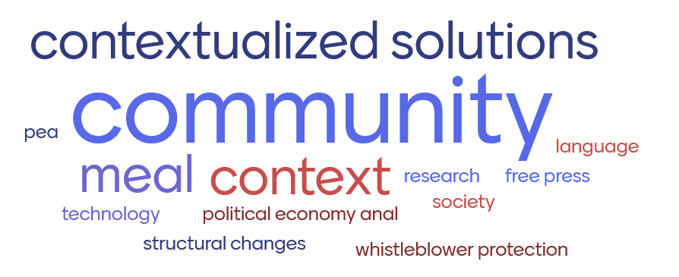
Contextualized solutions are needed. A standard checklist or set of procedures may not address who controls decisions, contracts or land in a particular setting. Creating a separate multi-stakeholder body does not automatically remove those risks: the same influential networks may remain involved, while accountability to public institutions and communities becomes less clear. Risk assessments should examine these relationships before choosing an oversight arrangement.
Questions NGOs, donors, governments and others working on climate change projects should ask:
- Anti-corruption approaches may assume a clear separation between the public and private sectors. However, the reality may be more nuanced and complicated. With climate projects, it is particularly important to understand local political-business networks such as around land transactions. How do they operate in practice, and what incentives does this create
- Development finance also has its opposite: anti-development finance, that is, money from illicit activities that seeks to influence policy or legitimate money that seeks to unduly influence politics. It is particularly important to understand how political and election finance relate to natural resource commodities and sectors: Are quid pro quo deals related to natural resources an open secret? Do these transactions over natural resources increase before elections? And how do these relate to climate projects?
- Do aid-supported governance models (such as hybrid public-private partnerships) bypass laws and democratic processes, or strengthen them?
- Civic space and intimidation (or worse) of environmental and human rights defenders: What are the trends in law and practice?
Recommendations from people with lived experience of corruption
It’s equally important to ask people with lived experience of corruption what solutions they would like to see enacted. Their ideas sometimes differ from the recommendations of anti-corruption professionals. People whom Rebecca interviewed made the following recommendations to address, prevent and resolve corruption:
- Language
- Project funders and managers must ensure that climate change issues are explained in ways that local people can understand, both in terms of words used and via the use of local languages. Concepts such as climate change and carbon credits need to be explained carefully so people signing agreements for carbon credits, for example, can give free, prior and informed consent (FPIC).
But for the community members to own this issue and recognize it as a problem, the language allowed around climate change, can it be localized…?
Now, corruption comes in when a public participation is not done properly…
And ask the community, which projects do you want? Now, with the knowledge about climate change, the communities will be in a position to influence decisions, and also to direct resources towards mitigation… mitigating climate change. But now, they don’t have knowledge. They can’t influence projects. They can’t actually even give an opinion about such projects.
- Government systemic/structural changes
- Provide accessible reporting channels linked to a clear process for investigation, referral and feedback. Use existing oversight institutions where appropriate and explain who is responsible for acting on complaints. Ensure offline channels exist for those without internet access or technology.
- Publish project budgets, contract awards, expenditure and delivery information in formats people can use. Combine online disclosure with local-language explanations and offline access where needed. (An example can be found in Open Checkbook, the online posting of all government spending so the public can access details about where funds were spent.
- Tie disbursements to cross-party commitments that protect strategic infrastructure from political transitions.
- Communities
- Include community members directly in project decisions and monitoring, with opportunities for women, young people and less-connected households to be heard alongside local leaders.
- Strengthen local institutions to reduce corruption.
- Increase efforts to combat community leader corruption and implement community-led solutions. One interviewee attributed demands for bribes by community leaders to their lack of understanding of the real impact of a project and an ensuing desire to receive their “share” before the implementing NGO “takes” the funds. Thus open discussions about local and regional issues that led to the selection of the particular project as well as how the project will benefit the community may lead to fewer demands for bribes from local leaders.
- Foster community buy-in so residents will be motivated to report fraud. Enable people to report concerns safely and provide feedback on what happened after a report. Ensure systems protect whistleblowers from retaliation.
- NGO/government – project management
- Fund robust monitoring, evaluation, accountability and learning (MEAL) systems. Establish independent back-checks that compare delivery records with recipients’ accounts and physical observations. Record discrepancies, assign responsibility for follow-up and document corrections before approving unsupported cla
- Conduct political economy analyses (PEA) to understand local political climates, who controls approvals, contracting and disbursement of rents, which individuals, parties or organizations will oppose or hinder a project and relationships within implementing and funding organizations. Revisit the assessment as project conditions change.

- Society
- Freedom of expression and a free press are critical to expose corruption by governments. In particular independent domestic and international media outlets must be champions in the fight against embezzlement, diversion of funds, etc.
- Freedom of expression and a free press are critical to expose corruption by governments. In particular independent domestic and international media outlets must be champions in the fight against embezzlement, diversion of funds, etc.
- Technology
- New technologies can be employed to reduce corruption. GPS coordinates, time-stamped records and photographs document field verification and can be checked against recipient accounts and other evidence.
- Digital payments directly to beneficiaries may reduce fraud – but can also create barriers among people who do not have digital devices that can accept those payments and might need to go to intermediaries to receive their funds.
We simply accept, as a normal practice.
Many donations and many aids are diverted by government officials.
Really, I am hopeless from the side of the government.
Now-a-days, the people feels non-governmental organizations (NGOs) have no meaningful contribution to change its life, by the way. Because of the corruption, and because of what? Corruption either in employment. Diversion of funds. When the society reached the point of hopeless.
What we hope you’ll take away
NGOs, development banks, ODA governments and other development partners need to actively monitor the extent of corruption in climate projects and must proactively take steps to counter it during all phases, from selection and contracting to delivery and then evaluation. It is their duty as responsible development partners. A general acknowledgement that corruption is a risk in the project’s context is insufficient – there should be an anti-corruption mindset among funders, implementers and regional stakeholders. Most importantly, development partners need to place a higher value on ending corruption in climate projects than on protecting institutional prestige.
Remember: A photograph of a cookstove does not establish whether a household received its agreed-upon payment. Political approval for a project, a location or specific subcontractors does not mean resources are being channeled to areas of greatest need or organizations of the highest quality. Corruption takes many forms.
Awareness is the first step – and assertive, preventive anti-corruption systems are the second and all subsequent steps. Continuous learning is key.
Editorial cartoon by GaMMZ. First published in the Standard, Kenya. https://x.com/kiddoGAMMZ