
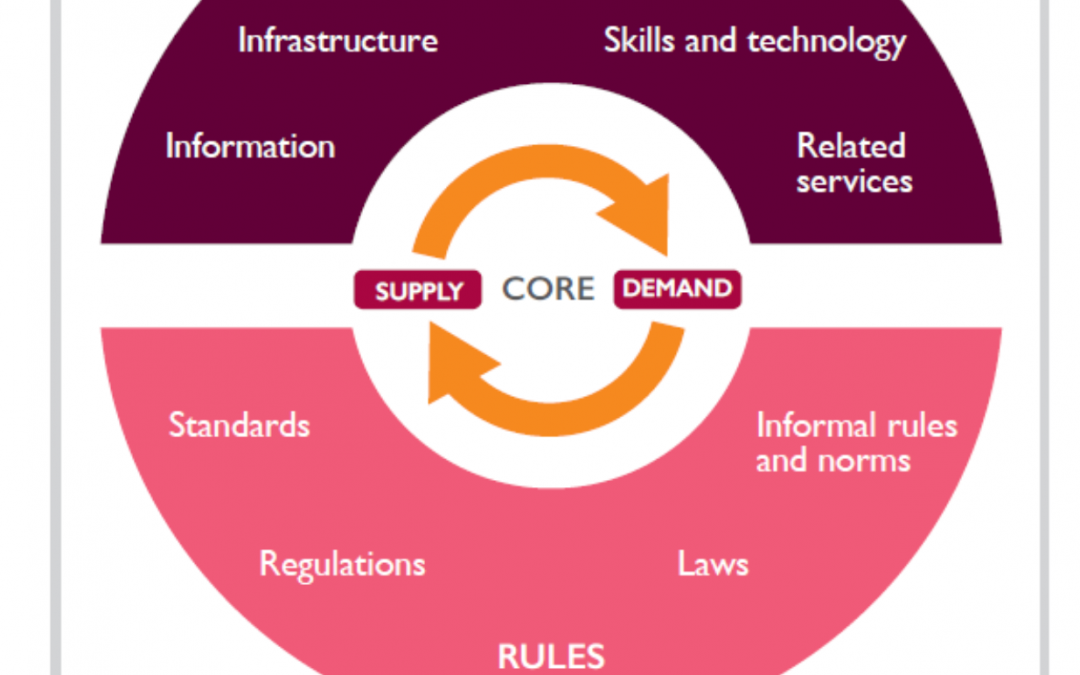
How do you raise people out of poverty? How do you improve economic conditions in a low-income region or country?
Private sector development (#PSD) has been a long-standing answer. Donors support micro, small and medium enterprises (#MSMEs) by providing training in #business management topics such as marketing, making a business plan, handling employees, sourcing materials and expanding to additional markets. When small businesses thrive, they hire more staff – improving the incomes of additional people; those incomes are then spent on local goods, boosting the local economy.
However, detractors complain that PSD is too micro – it helps individual business owners, but
- doesn’t change the market system overall (such as onerous government regulations or unequal access to resources) and
- requires continuous input from development donors, to pay for individual trainings for additional business owners
Enter market systems development (#MSD), which seeks to improve the economic system as a whole by improving the systems that support the market.
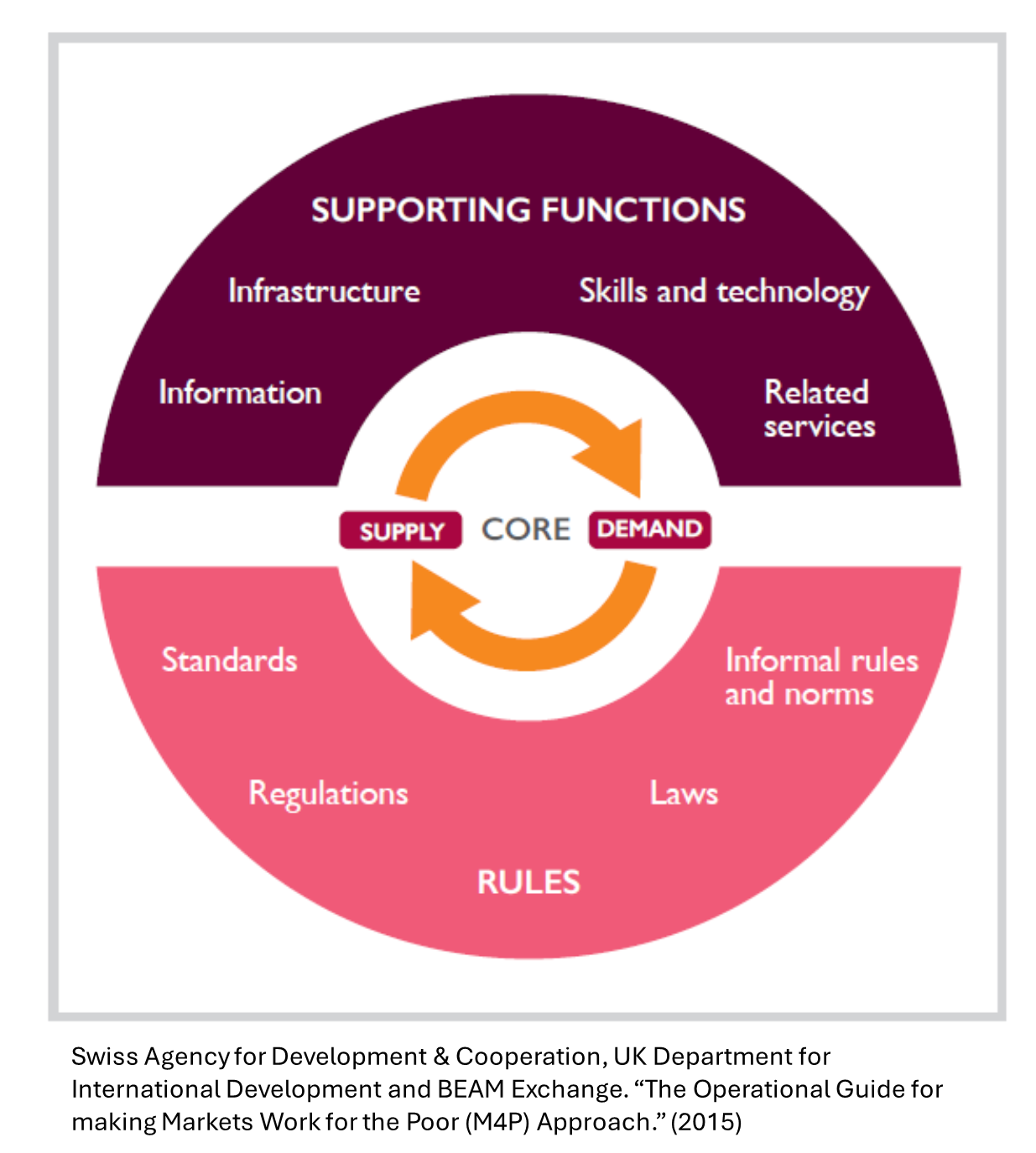
At the center of the market system are suppliers and users of goods and services – the market exchange. Around that core are:
- supporting functions – the skills, support services, infrastructure and information that enable the sale and purchase of those goods and services. Supporting functions can be physical or digital infrastructure, upstream suppliers of manufacturing inputs, access to finance or training, information about market conditions, updates from government agencies and services the supplier needs to run the business (transport of goods, IT experts to fix offices computers, mechanics to fix machines, etc.).
- rules of the game – the formal regulations and laws as well as informal rules regarding how business is conducted and who has power. These can include labor and trade laws, enforcement of laws, the legislative and regulatory environment, cultural views on woman or certain ethnic groups, existence of quality standards, formal vs. informal trading and business associations.
In an MSD approach, there is a focus on understanding failures in the market system and the root causes of why the market doesn’t work for the poor. MSD seeks to change how the system functions so that it improves the ability of poor people to engage in the market, as both suppliers and purchasers. The goal is sustainable change in the market so that continued support by donors is no longer necessary. MSD projects thus seek to be facilitators – agents of change who facilitate systemic improvements without becoming permanent fixtures of the marketplace.
Comparing PSD and MSD
| Aspect | PSD | MSD |
|---|---|---|
| Who is served | Small businesses (MSMEs) | Businesses and systems that support MSMEs |
| Type of service | Direct service – provision of training | Indirect service – help supporting businesses improve their ability to serve the poor, encourage changes to government regulations |
| Government involved? | Overall, no | Should be, in some way |
| Duration | Short-term – training is provided, project ends | Long-term – improvements to supporting functions and changes to the rules of the game should lead to sustainable changes in the market system after the project ends |
| Examples | ||
| Finance | • Provide microgrants to MSMEs • Support financial institutions that provide microgrants |
• Help financial institutions expand into new markets, such as rural areas, by facilitating connections, proving the business case for the expansion and helping government agencies change the regulatory environment |
| Training | • Train job seekers in vocational skills (carpentry, cooking, cell phone repair) • Hire TVETs to train job seekers |
• Facilitate expansion of TVETs from vocational skills (carpentry, cooking, cell phone repair) to include business management topics (marketing, hiring employees) so graduates can open own businesses |
| Goods | • Provide MSMEs with fiberoptic cables and modems • Buy equipment from local distributors or pay them to provide the goods to the MSMEs |
• Help city manufacturers develop a business model in which rural stores become points of sale for fiberoptic cables and modems |
Table inspired by: USAID and SCALE. “Comparing Standard and Market Systems Development Approaches to Rural Employment.” (2021)
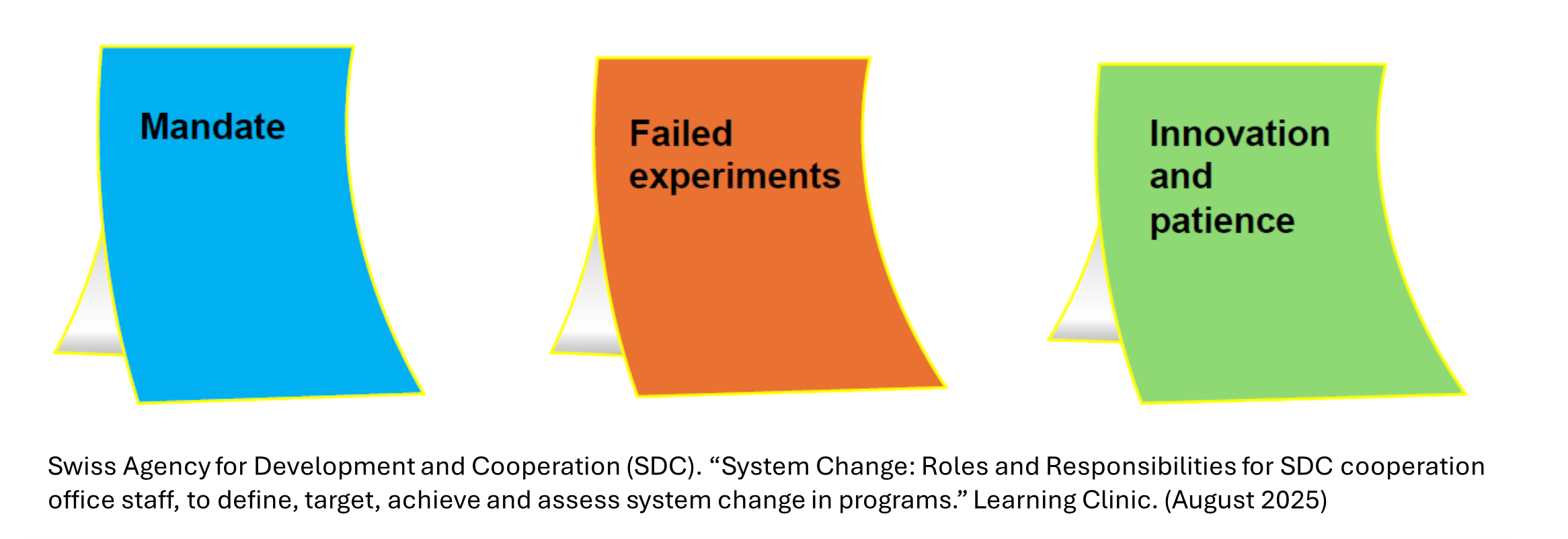
MSD is often a trial-and-error process, with certain sectors being dropped if they are not successful after the pilot intervention or some partners being replaced by others who show more commitment, e.g. through co-investments. As the graphic demonstrates, success only comes from experimenting and creativity.
Typical MSD projects can involve:
- working with governments to improve regulatory enforcement and updates to regulations on imports and exports, taxes and business regulations
- connecting upstream and downstream businesses, such as suppliers of manufacturing parts and factories
- supporting or developing capacity-building organizations that can provide training to business owners and employees, including agricultural extension training
- improving MSME’s access to financial products (financing, insurance)
- improving the quality of products so they will be more attractive on the market, including to international buyers
- increasing productivity through the use of better technologies and methods, especially in agriculture
Market Systems Development projects can address failures in a wide range of market sectors. The SDC’s Private Sector Partnerships for Health (PSPH) in Somalia/Somaliland, sought to provide Somalis, including the most disadvantaged, with better access to quality and affordable health services. The private sector provides essential healthcare services but health insurance was lacking. In Phase 1, the project pioneered new health insurance products and linked public-private discussions with the government. Ultimately, 1.6 million patients access health services in PSPH-supported facilities and 48 market interventions were supported.[1] The current phase focuses on health financing products to reduce high out-of-pocket payments.
BEAM Exchange’s Evidence map (https://beamexchange.org/results/evidence-map/) provides a list of programs that have been effective in making enduring changes to a market system, helping the market function better for poor people and showing a correlated reduction in poverty. For example, USAID’s Transforming Market Systems project in Honduras led to the creation of almost 50,000 new jobs (18,000 for women) which paid $5,000 a year on average – an income increase of almost 150%. 78% of the jobs were created directly by supporting the growth of local businesses and 22% were created indirectly by lowering business constraints and stimulating local labor and product demand. Sectors that benefitted include construction, services, manufacturing and agriculture.[2]
Case study: InovAgro, Mozambique – certified seeds
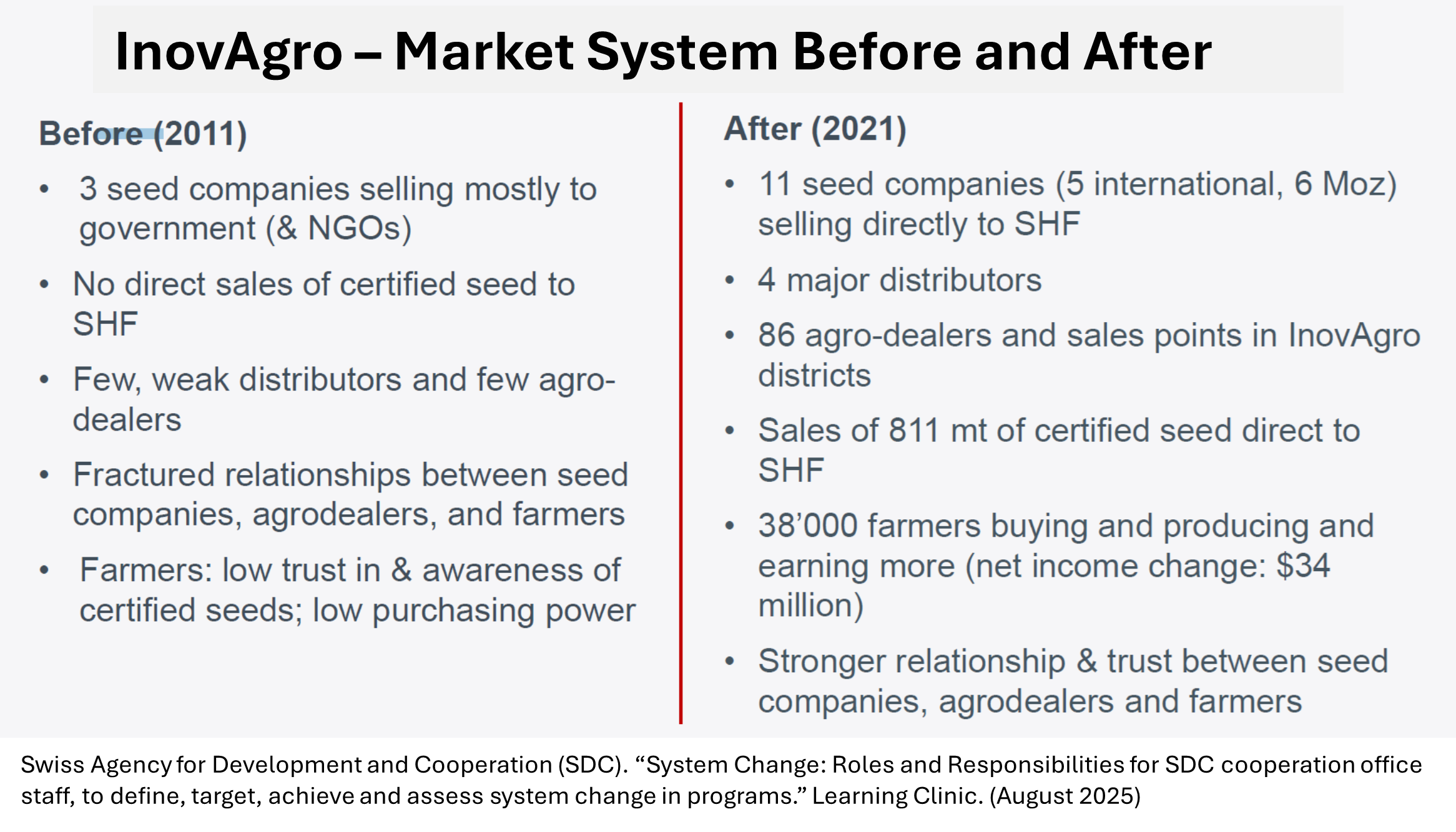
In the first MSD project in Mozambique, the InovAgro project sought to sought to transform a weak market context not working for the poor into one that was servicing the needs of poor smallholder farmers. Lasting 11 years over 3 phases, the project started by attempting to connect farmers to large agricultural buyers but the barriers were too great. The strategy transformed into one focusing on agricultural inputs – certified seeds – and extension services that would educate smallholder farmers about the benefits of good agricultural practices (#GAP).
At the time, seed companies did not have a permanent presence in northern Mozambique. Through demonstration plots and field days, the project built awareness and drove demand, such that 10 national and multinational seed companies began targeting the smallholder farmers. In addition, new seed distributors entered the market, reaching last-mile consumers. By the end of the project in 2021, the seed companies worked with 85 retail outlets as well as village-based agents and lead farmers. Their relationships enabled the continued sale of seeds even during the COVID-19 pandemic.
InovAgro also worked with the Ministry of Agriculture and the National Seed Authority (NSA) to develop the private sector seed inspector (PSSI) initiative, which benefited the seed industry at a national level. InovAgro helped develop the regulation and held the first PSSI training in 2018. By 2021, multi-sectoral engagement supported the training, with big seed companies covering 70% of the training costs and smaller seed companies co-financing with development agents. “This crowding in of donor support and willingness of private sector to invest, will ensure that the initiative will continue.”
By the end of the project, InovAgro had facilitated increased incomes for over 25,000 smallholder farmers for a total net income crease of $34 million.
Other aspects of the marketplace improved. The government stopped subsidizing the purchase of seeds – ending the market distortion. Village Saving and Lending Associations (#VSLA) developed savings windows dedicated to the purchase of certified seeds and other inputs; by organizing at the district level, they were able to negotiate directly with seed companies to purchase seeds at lower prices and receive additional services such as demonstrations. In addition, commercial financial institutions are now offering agency banking – branchless banking in which licensed financial institutions use mobile/POS technology and third-party agents such as small businesses who operate as local ATMs in their communities.
Wiliam Grant, DAI. InovAgro Moçambique. “InovAgro’s Voyage of Learning and Adaptation for Market Systems Development in Northern Mozambique.” (December 2021)
Case study: Bomet County, Kenya – biofortified seeds
An example of success in changing the market system occurred in Bomet County, Kenya. To combat the acute malnutrition among children under five, the county government wanted to promote #biofortified beans and sweet potatoes. Biofortification involves breeding crops to increase the minerals or vitamins they naturally have so they provide more micronutrients, in this case iron and zinc (beans) and Vitamin A (sweet potatoes).
Dennis Mutai, County Crop Development Officer, says the system was broken [3]. The government used to provide subsidies to farmers to buy biofortified seeds, but that approach is not sustainable.
He used an MSD approach to identify why the system was not working and to create “sustainable change”. First, farmers didn’t understand the value of biofortified crops. He therefore engaged in a sensitization campaign, holding meetings with farmers and managing demonstration plots – fortunately, the biofortified seeds mature faster and have higher yields, which impressed the farmers. Thus demand for biofortified seeds increased.
Consumers also increased their demand for biofortified products. Pregnant women in the region eat a certain clay said to be high in iron and calcium. But women farmers who grow biofortified crops no longer need to eat the clay. In addition, processors use the fortified beans to make bean flour for porridge.
The county also built the capacity of seed dealers to stock biofortified seeds, enabling them to meet the increased demand from farmers. Finally, commodity buyers now purchase larger quantities of beans and sweet potatoes at higher prices, which in turn raises the income of the farmers.
Mutai focused on #marginalized groups – youth and women – to increase their skills as farmers and traders. The county government facilitated changes, but then could then step back because the market system was now working, especially for the poor. In fact, the initiative was so successful that other counties have adopted it.
Market Systems Development initiatives have proven the success of the approach. Nevertheless, there are criticisms of how MSD projects are implemented – a topic to be discussed in the next blog.
[1] SDC. Private Sector Partnerships in Health (PSPH). https://www.eda.admin.ch/countries/somalia/en/home/
international-cooperation/projects.html/content/dezaprojects/SDC/en/2018/7F10062/phase2.html
[2] USAID. Transforming Market Systems Activity Annual Report FY2023. (2023)
[3] Interview with author, 28 January 2026.
this is so insightful especially the difference between PSD and MSD. for sure we needed MSD from the word go
Yes, MSD is a powerful way of approaching employment opportunities as well as #MSME expansion