
Market systems development (#MSD) is a powerful way to stimulate changes in the marketplace – by improving how goods and services are bought and sold and stimulating support services so the marketplace expands to better serve the poor.
However, MSD projects can have weaknesses in how they are implemented.
- Projects have to pick sectors they will work in.
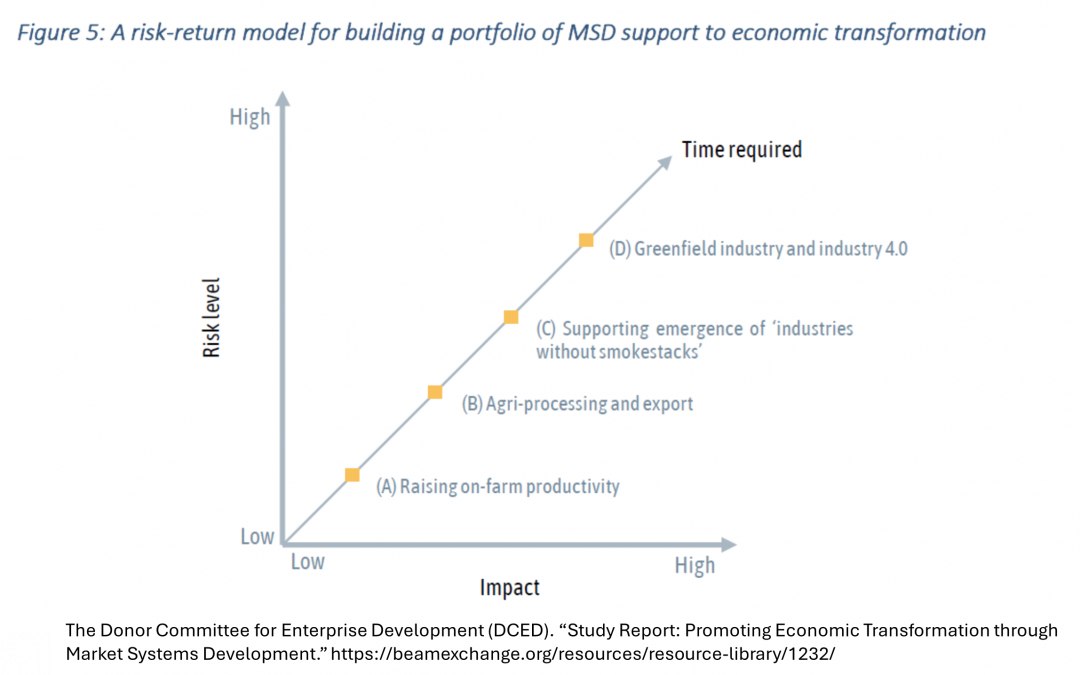
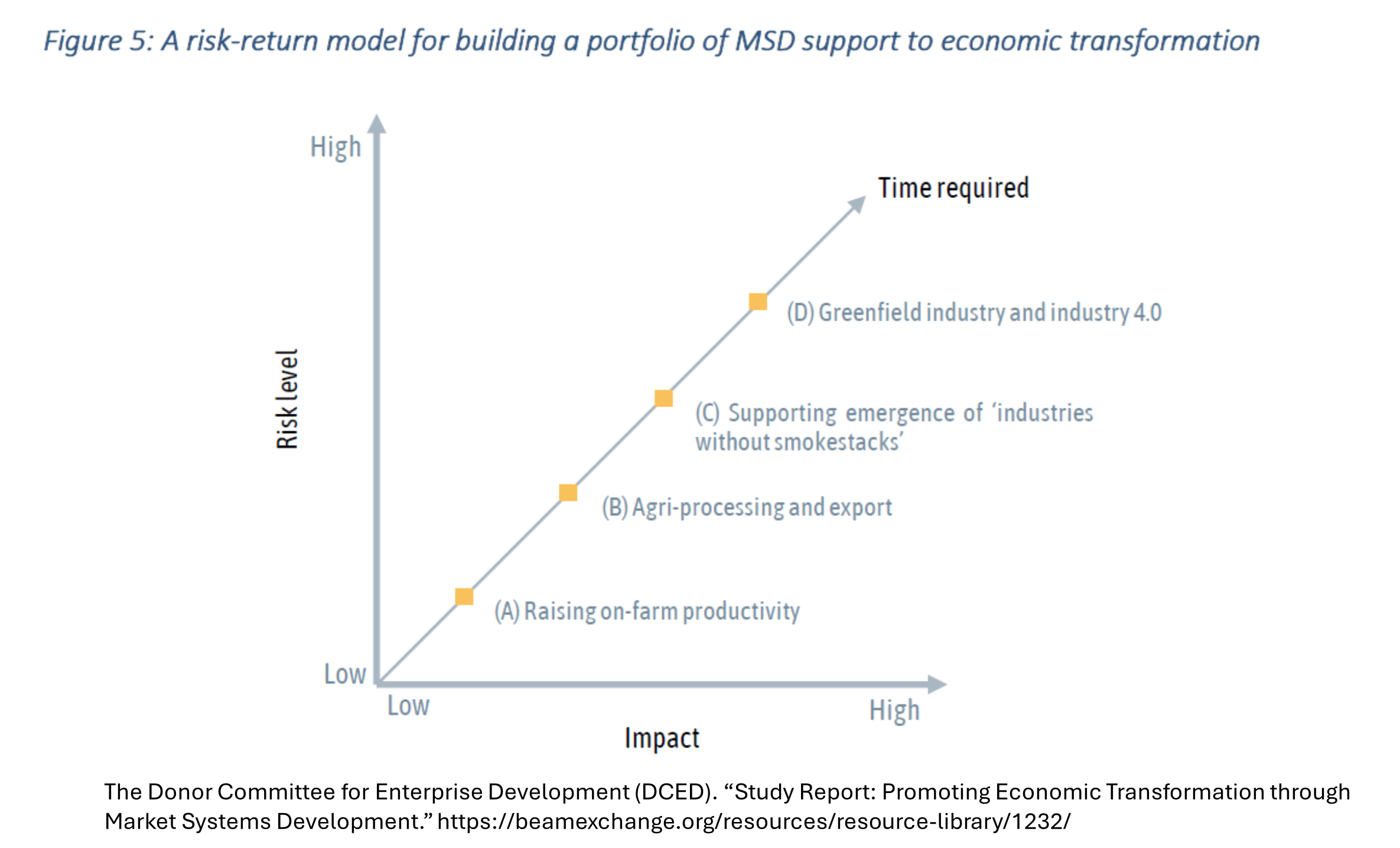
This decision-making process usually involves looking at where the poor are currently and not what the market will look like in 10 years given the disruptions from innovations. Many MSD projects focus on agriculture, because smallholder farmers produce a large portion of food in many countries and so many poor work in agriculture. In addition, farming is an industry that can be improved with inputs such as new technologies and climate-resistant seeds as well as improvements to the agricultural extension programs which provide training on technologies and topics such as irrigation, climate-friendly farming practices and crop storage and processing techniques.
However, what market sectors will be dominant in a decade? So-called “industries without smokestacks” (#IWSS) are already providing new opportunities for growth, particularly in Africa, in fields such as tourism, food processing , renewable energy, information and communication technology (ICT) services, horticulture and floriculture. In Rwanda, industries without smokestacks employ four times as many workers as manufacturers do and in Ethiopia and Rwanda tourism offers more jobs than manufacturing. In fact, African service exports make up approximately a quarter of the continent’s export earnings.[1]
Because it is difficult to predict what industries will flourish in coming years, MSD projects may choose the safer option of well-known industries such as agriculture.
- MSD projects are often weak in the area of Political Economy Analysis (#PEA).
| A political economy analysis (#PEA) looks at the underlying issues in a national, regional or local political system, including the distribution of power and wealth; which stakeholders hold power and what types of relationships exist between stakeholders; what the informal rules, cultural norms and assumptions are; how various demographic sectors – gender, ethnic/religious, regional, age, political, marginalized groups – have an impact on and are impacted by the existing system; and how decisions are made in actuality outside formal structures, such as through patronage and rents. |
It is by understanding the currents beneath the surface that MSD projects can attempt to make positive changes.
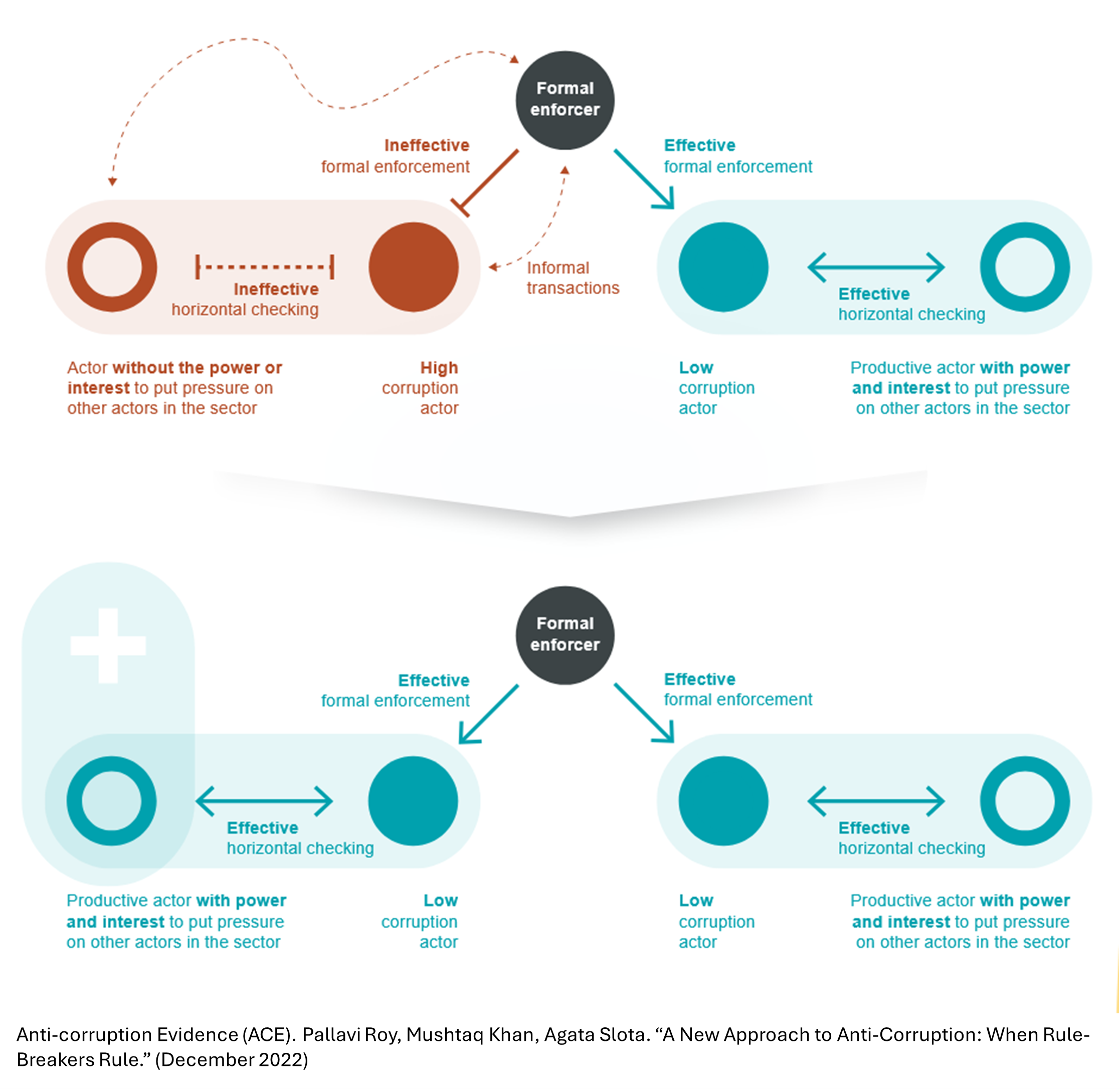
MSD projects should be considering these political economy issues when they do a market systems analysis (#MSA) at the beginning of the project. However, Alan Husdon and Luis (Lucho) Osorio-Cortes found that challenges in policy engagement are common in MSD projects and that PEAs are not always used effectively. They propose a SOAS-Anti-Corruption Evidence (ACE) approach, which attempts to understand the behavior of actors regarding the flow of resources and how actors are influenced by their own self-interests, relationships with other actors and the systems they are in.
The goal is to understand what policies will be effective by leveraging stakeholders’ self-interest and peer monitoring to prevent rule breaking. (See graphic below) By identifying stakeholders who are deviating from the norm in good ways (“positive deviance”) and then examining the drivers of that behavior, development practitioners can better design policies where incentives are aligned with the policy goal and it becomes in stakeholders’ self-interest to comply.[2]
According to Hudson [3], a lot of PEAs are not useful because they don’t look at actors’ behavior and natural incentives. Once sufficiently powerful stakeholders are engaged in the target behavior, there is a natural “horizontal check” on inappropriate activity.
However, Steven Geiger [4], Senior advisor PSD at the Swiss Agency for Development and Cooperation (SDC), disagrees strongly. In his experience, PEAs are a core part of the Market Systems Analysis (#MSA). In one project looking at value chains in Mozambique, selection criteria included issues such as the impact on the poor as well as political feasibility. One value chain was excluded because there were too many political interests that made reform unlikely; the government was crowding out other players. Because the SDC is a major player in the MSD field, its projects may require robust PEAs in a way that projects from some other donors do not.
- Projects don’t or can’t work on rules of the game.
The rules of the game include formal and informal conventions regarding who holds power, how money and influence flow (from whom, to whom), how political systems are interconnected and the interplay between policies and reality – everything related to government as well as civil society organizations (CSOs). As a recent blog in the BEAM Exchange explains, improving policies and regulatory systems can make the playing field more level, reduce information asymmetries, tackle externalities such as pollution and target marginalized groups.[5]
MSD projects often focus only on the private sector – sellers and buyers of goods and services. The Donor Committee for Enterprise Development’s (#DCED) Study Report “Promoting Economic Transformation through Market Systems Development” notes that while government engagement is part of MSD theory, “in practice MSD programmes have tended to work ‘around’ political institutions rather than engaging ‘with’ or working ‘through’ governments to achieve systemic change. As one Working Group respondent noted, ‘There is a natural tendency to look at governments as an impediment rather than an enabler of MSD’.”[6] Hudson also feels the market is overemphasized when in actuality it is only one aspect of the social system in a region.
- Projects report to donors, not to governments.
Despite MSD’s goal of improving market systems, by focusing accountability on the funder these projects reinforce the message that the government is not a valuable stakeholder and does not bear responsibility. Certainly, some major donors, such as the SDC and USAID, have traditionally involved government as active partners in MSD projects in order to facilitate the identification of bottlenecks and ways the government distorts the market.
- Time frames are too short to prove systemic change.
A 3 or 5-year project may show improvements and changes in the market system, but systemic change needs a longer time frame for evidence to be robust in proving the changes are sustainable. This disparity can lead to donors requiring watered-down versions of “system change”. According to Husdon, some donors chase simple solutions rather than attempt to understand the dynamics in the target context. For him, the goal is not about outcomes but rather about nurturing more effective, locally-led learning and increasing the community’s capacity to tackle problems.
According to Geiger, SDC projects last 10-12 years, with multiple phases built in, a time frame that is necessary for substantial, sustainable systemic change that is scalable. Due to internal funding issues that preclude longer planning horizons, some donors run sequential projects, with the result that the implementers of the second phase may not be the ones who ran the first phase of the project and thus they lack the intimate knowledge of the initial implementer.
- Donors seek standard solutions.
Some donors may not fully understand the MSD approach and instead prefer certain activities such as grantmaking. This lack of flexibility will hinder the testing and creativity that are necessary for successful solutions to be identified and scaled. Donors need to be willing to drop 20% of the least sustainable and least effective interventions.[7]
Photos: Dennis Mutai
- Projects seek incremental changes rather than large-scale improvements.
In many MSD projects, a 10% or 20% improvement in income is considered success – even though incomes may need to improve by 100% or 200% to bring families out of poverty. This issue is also tied to the tendency of MSD projects to focus on lower-risk sectors, such as agriculture, rather than disruptive innovation.
Geiger, however, feels that even incremental improvements to income will help poor people achieve higher incomes over a longer time frame. Through changes in the business environment, Micro, Medium and Small Enterprises (MSMEs) can grow, in turn raising incomes and increasing employment opportunities. Improving the capacity of business development companies, who in turn provide technical assistance to MSMEs, can enable small businesses to grow at a rapid pace. He cited one example in which sales increased 70% in 6 months.
Alexander Hurst [8], Director of Inclusive Investment at TechnoServe, engages in MSD-like activities by helping businesses become commercially viable through indirect interventions – i.e., the facilitation role defined by MSD theory. He works on system changes in a marketplace or value chain from the bottom up and does not necessarily address the entire system, such as government’s role. Similar to the MSD approach, Hurst focuses on making markets work for the poor and screens projects for #gender viability. He often focuses on the agriculture value chain, providing training of trainers (#ToT) to address knowledge gaps, digitalization, logistics, networking and distribution assistance and extension services. He has found that smallholder farmers are commercially competitive and viable, more so than commercial farms in Africa.
Hurst has seen how not just governments but NGOs can distort marketplaces when they embed themselves in the market system, even if the goal is altruistic. For example, governments or donor projects may purchase farm commodities for redistribution, such as for school meals, or provide free or subsidized inputs, such as seeds. Intermediary businesses cannot develop when these products or services are provided for below-market rate and the market system will remain stunted.
For Hurst, one major challenge is being overwhelmed by the complexity of the situation. He enjoys working from bottom-up but believes the private sector cannot do it all – policy levers are needed. He wishes there was more coordination between governments and funders; often, parallel projects are not aware of each other, leading to fewer efficiencies and lower impact than if there were better synergies.
In conclusion, the literature shows clear success in the use of an MSD approach to facilitate sustainable and scalable change in market systems in ways that benefit the poor, women and youth. However, MSD projects require patience from donors. First, sectors and partners need to be tested, which inherently implies a level of failure that is not common among donor projects. Second, true systemic change is complex, with diverse stakeholders – government, large corporations, MSMEs, NGOs and CSOs as well as workers – all contributing to and being affected by the formal and informal rules and infrastructure surrounding the marketplace. When done well, MSD projects lead to long-term changes in the market system. But care is needed to ensure MSD principles are properly adhered to and implemented appropriately.
[2] Alan Hudson and Luis Osorio-Cortes. “Building bridges for more effective policies: Market Systems Development and the SOAS-ACE approach to political economy analysis.” (December 2025) https://docs.google.com/document/d/1RCy9eayxE6dxWvYz6BSq7uE5qVBulsEKEnDvECMjIck/edit?tab=t.0
[3] Interview with author, 13 January 2026.
[4] Interviews with author, 22 January 2026 and 3 February 2026.
[5] BEAM Exchange. “Changing the rules of the game: policy related interventions.” https://beamexchange.org/learn/intervention/policy-related-interventions/
[6] The Donor Committee for Enterprise Development (DCED). “Study Report: Promoting Economic Transformation through Market Systems Development.” https://beamexchange.org/resources/resource-library/1232/
[7] USAID and SCALE. “Comparing Standard and Market Systems Development Approaches to Rural Employment.” (2021)
[8] Interview with author, 15 January 2026.
I love the acknowledgement by Hurst that smallholder producers are commercially competitive and viable! What fails them is lack of favorable structures: poor roads for example! Commercial farmers own tractors that can enable them ferry their produce even with the poor roads, but the smallholder producers are left in the mercies of middle men who blame the low prices on logistical costs
Well said, Lenah. Infrastructure is definitely important – and the responsibility of the government.
I was also pleased to hear Alex say that smallholder farmers are more successful than commercial – what a great testament to the importance of families feeding their communities and beyond.