
Can governments achieve policy goals by giving things away for free? Two programs in different parts of the world both test this approach.
Free buses
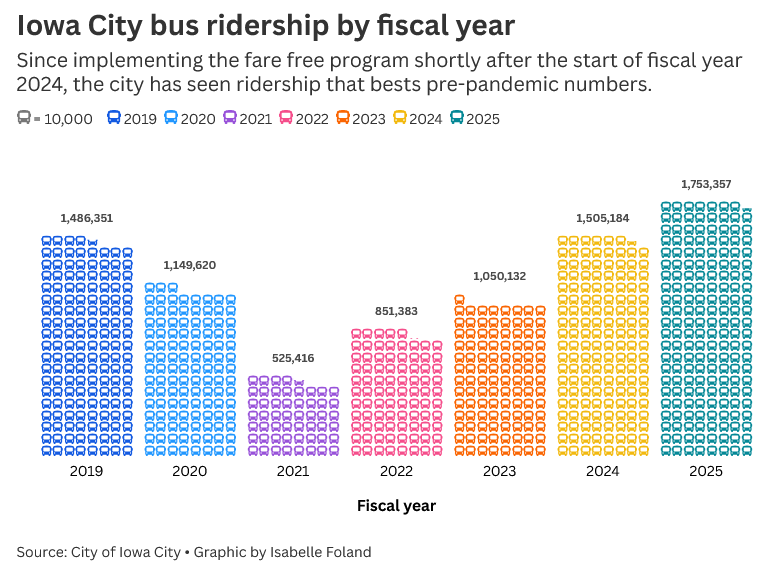
The first program comes from Iowa City in the US state of Iowa, In 2023 the city launched an initiative making buses free to ride. An initial 2-year pilot was successful and the initiative was extended another year.
“In the first two years of the program, the city saw a 68 percent increase in ridership on its buses as well as $3 million in savings for residents who took the cost-free buses, said Darian Nagle-Gamm, the city’s transportation director.”
Due to the shift from driving to public transit – the equivalent of taking 5,000 cars off the road – pollution has decreased.
Funding comes from various federal, state, and local sources, but one main federal pot expires in September 2026, putting the initiative at risk. The city attempted to raise parking fees but had to withdraw that plan. Ironically, demand for parking spaces has decreased due to increased use of buses. The city has identified a more stable source of funding: the fees that gas and electric utilities pay for their use of public areas to deliver services. The franchise is increasing from 1% to 2% as of 1 July 2026, which will be passed on to consumers at a rate of 1 additional cent for each dollar in the utility bill. This increase is expected to generate $1 million in revenue annually.
Other U.S. cities have had free bus ridership programs.
Compensating women for their (unpaid) domestic labor
The second program takes place in India, where 118 M women in 12 states (almost one-fifth of adult women) receive cash funding for their traditionally-unpaid family labors. Unpaid Domestic and Care Work (UDCW) prevents women from accruing assets and devalues their work compared to paid labor.
Known as Unconditional Cash Transfers (UCTs), these payments do not require the recipients to perform tasks to receive the payments, though recipients must be from economically-disadvantaged households and cannot have jobs.
Note, however, that some states give funds only to married, divorced or widowed women while others target single heads of household, including unmarried women. Barring never-married women from receiving payments can reinforce norms about marriage being compulsory for women.
The payments of €9 – €25 represent 5% – 12% of the women’s monthly household income, depending on the state.
Also not having to grovel before husbands for money for daily expenses restored dignity and financial freedom to women. As one woman from a small village articulated:
Whether we are in a nuclear family or a joint family, we should always have to go and beg the men of the household for money, even for a tiny amount like 50 Rs or 100 Rs. We have to explain to them that the vegetables are over or we need to buy the cylinder etc. They would also keep delaying giving the money saying I will give it tomorrow or day after tomorrow and so on. Now since we have the money on hand or in the account, we are able to spend it as and when we need it. This amount has made me enjoy that financial freedom however small the amount might be.
The transfers give women financial security and confidence, since they have regular access to funds independent from their husbands’ wages. Funds are often used for household needs, including children’s education.
One criticism of UCTs is that they will discourage work. However, researchers studying five Indian states found no evidence that the payments disincentivise employment.
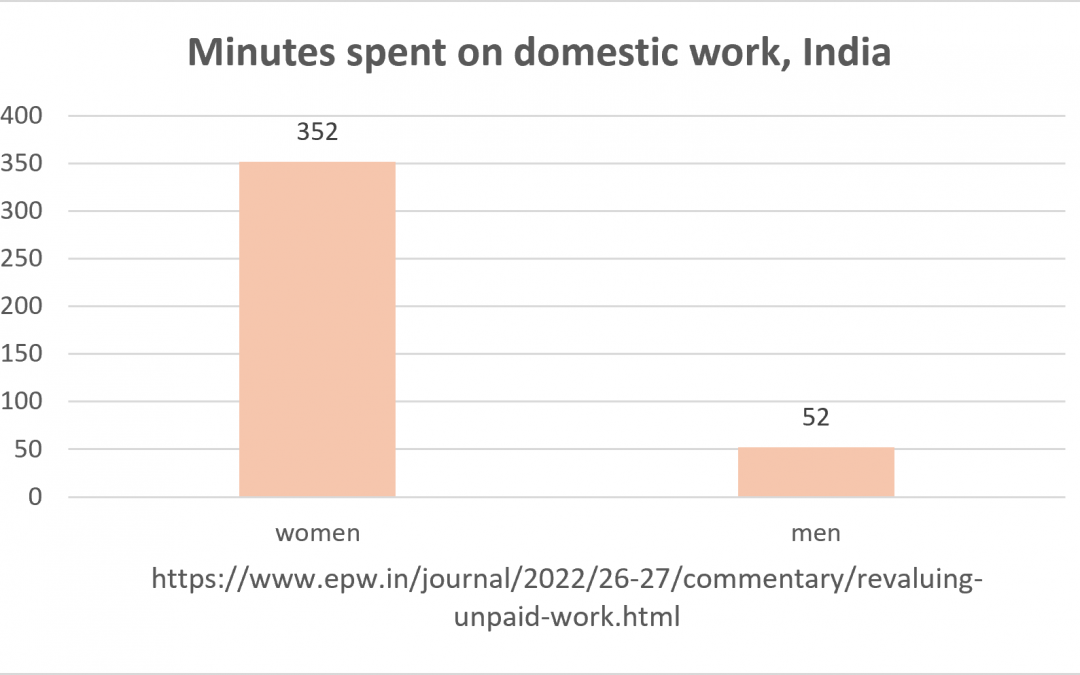
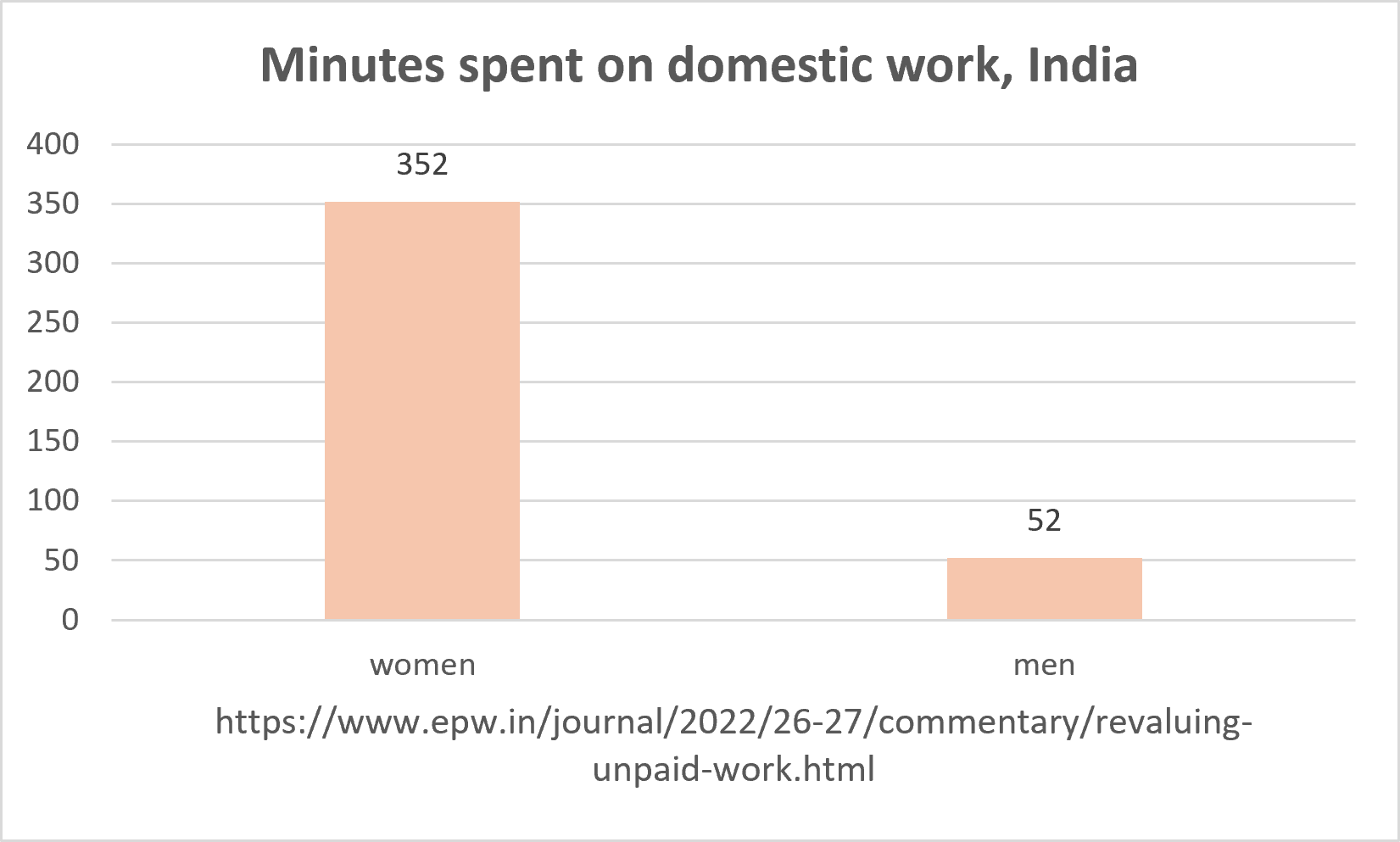
The 2019 time-use survey by the National Sample Survey Office (NSSO) found that women spent up to 352 minutes a day (almost 6 hours) on domestic work while men spent 52 minutes – less than an hour (GoI 2020). Another goal of the UCTs is that they lead to a more fair distribution of household work by household members, which unfortunately has not occurred.
There is also criticism leveled at the UCT programs, that they are “vote buying”. Another criticism is that UCTs promote traditional female labors rather than encouraging women to join the workforce.
Researcher found payments in the state of Assam “…neither decreased women’s education or paid employment nor did it reinforce the gendered division of labour. At the same time, it did not dramatically improve their bargaining power within marriage or reduce domestic violence or improve chances for exit in the case of abusive marriages. Importantly, UCTs opened a line of access to cash however modest and assisted in meeting basic needs of the family.” (read her full article at: https://www.sciencedirect.com/science/article/pii/S0305750X25000324)
Nevertheless, recognizing the financial savings households enjoy when one member stays home to take care of children, elders and housework, is a significant step towards bringing respect to unpaid labor.