
by Rebecca Laes-Kushner, David Aled Williams and Barret Mbuvi Kamunzu
Rebecca Laes-Kushner is an NGO consultant, providing research, data analysis, MEAL and training services to NGOs in developing countries.
David Aled Williams, PhD is a Principal Adviser at the U4 Anti-Corruption Resource Centre and a Senior Researcher at the Chr. Michelsen Institute in Norway.
Barret Kamunzu is a researcher and MEAL practitioner based in Kenya, supporting programs across East Africa, with extensive experience in donor-funded projects and refugee programs.
Part 1 of this series combines a brief introduction to corruption based on Aled’s research on corruption in climate change projects and Barret’s firsthand experience of program delivery and verification in Kenya with the results of Rebecca’s exploratory mini-survey of stakeholders in climate change projects who experienced one or more types of corruption.
This part dives deeper into the issue through key informant interviews that Rebecca held with survey respondents and covers experiences of corruption from Rebecca’s interviews with survey respondents and Barret’s personal experiences as a development professional.* The accounts illustrate how corruption risks arise and how organizations might respond; they do not establish how widespread these practices are.
*Interviewees are identified by pseudonyms; the authors contribute under their own names.
What stakeholders said
Rebecca held key informant interviews (KII) with a subset of survey respondents to explore issues they raised in their surveys in more detail.
Rebecca: I wanted to hear directly from people who have experienced corruption to both understand the issues they face as well as learn what solutions they feel need to be implemented.
The corruption discussed by interviewees can be grouped into the following categories:
Political corruption
-
Political influence – Multiple interviewees said that development NGOs are forced to comply with the wishes of government staff or politicians regarding the types of projects, the siting of projects and how projects are managed.
-
Bribery – Bribery was a very common topic among interviewees. Jacob, a development worker in Africa, described how government offices require bribes, as do members of parliament (MP). Several interviewees said local leaders, such as tribal heads, will demand bribes before giving their approval for a project.
-
Community leaders have been cited by multiple interviewees as sources of corruption. NGOs may contact only a single local leader for approval on projects such as locking in land for carbon credits.
In other cases, communities are not provided with opportunities to give public input as required by law; disenfranchised minorities are particularly vulnerable.
In Spanish, it’s a word, clientelismo…you have a type of clients…within the Indigenous organization, and you provide different types of favors…for getting the signature, having the project move. Or just, give more prominence to certain indigenous leaders…for certain favors.
Business corruption
-
Businesses divert materials for projects according to Jacob, an East/South African development worker.
Barret: As a company owner, I bid for government and NGO tenders, both independently and through consortia. In this work, I have encountered solicitations for informal payments before contracts are awarded. This is sometimes described as “oiling the machine”—a phrase used to mean paying a bribe to secure an award. Such demands create a barrier for competent firms that are unwilling to pay. Relevant experience, technical capacity and a competitive proposal may not be enough when access to a contract depends on an unofficial payment. This undermines fair competition and raises questions about whether the selected contractor is best placed to deliver the work.
We simply accept, as a normal practice. Because it’s not a new issue. Many donations and many aids are diverted by government officials.
There is embezzlement by the way.
On both sides. On both sides, there is an embezzlement. Not only a government… not only the government, a billion [local currency], by the way. There are still officials within the [humanitarian] aid agencies, who are also responsible for embezzlement and corruption.
NGO corruption
-
False delivery claims can allow organizations or individuals to claim payment for supplies or activities that were not delivered. A related risk occurs when NGOs withhold benefits while giving participants incomplete information about the entitlements they are eligible for, such as carbon credit payments.
Barret: While supporting an audit of cookstove distribution in a rural community in Kenya, I found that carbon-credit payments owed to participating households had been withheld. The donor’s agreement with the local organization specified higher payments for households than the amounts stated in the agreements the organization gave them. Comparing these documents exposed a discrepancy between households’ actual entitlements and what they had been told they would receive. Without access to the donor agreement, households lacked the information needed to identify and challenge the withheld payments.
-
Collusion – Collusion can exist even in systems meant to promote integrity.
Barret: Verification can be part of the problem when those checking product delivery collude with those who distributed the products. In a distribution program, this can mean project officers approving inflated product quantities or beneficiary numbers in return for a share of the resulting payment. The process meant to expose false reporting thus helps validate it.
During back-checks for an agricultural livelihoods project in Kenya, I personally found a case where records showed 500 tree seedlings were given to a household but I could verify only 300. It illustrates why verification must include independent checks with recipients and follow-up when the evidence does not match the reported figures.
The discrepancy Barret found required investigation; it did not, by itself, establish collusion. Note, the seedling example comes from an agricultural livelihoods assignment but illustrates a verification practice relevant to climate programs.
Abuse of local people
-
Due to both linguistic challenges and the complexity of some climate change projects, locals are often insufficiently informed about the implications of projects they agree to participate in.
In my community, the language of climate change is in English.…if I was to talk to someone about climate change in my mother tongue, I don’t know exactly what I’ll be telling this person.
–Omar, development worker in the Horn of Africa
-
Carbon credits are a type of project that is ripe for corruption, especially when details of responsibilities and payments are not explained clearly to project participants. According to Tessa, an East African development worker, farmers often don’t understand that signing an agreement to plant trees for 10 years means they may not be allowed to graze their cattle on that land. Another interviewee concurred, saying the calculation behind the credits for reduced emissions are too complex for local people to understand – which leads them to being deprived of money they have rightfully earned.
Barret: I have seen rural communities in Kenya enrolled in carbon-credit projects and pressured to plant trees without sufficient consideration of local priorities, existing land uses or the value of that land to their livelihoods. Communities received very small payments, yet had little understanding of how the carbon credits were calculated or how their share was determined. This information gap creates room for exploitation. The details matter.
Before signing a contract, a household should understand which trees it must plant, how much land is required, how long the commitment lasts and whether it restricts farming or grazing. The financial explanation should be equally clear: how revenue is generated, which costs are deducted, how the household’s share is calculated and when payment is due. These terms should be explained in local languages, using examples which are based on familiar household and farming activities and terms. Participants should receive a simple record of their commitments and benefits, with time to ask questions and seek independent advice. Technical complexity should never prevent communities from understanding an agreement that affects their land and livelihoods.
Development funders
-
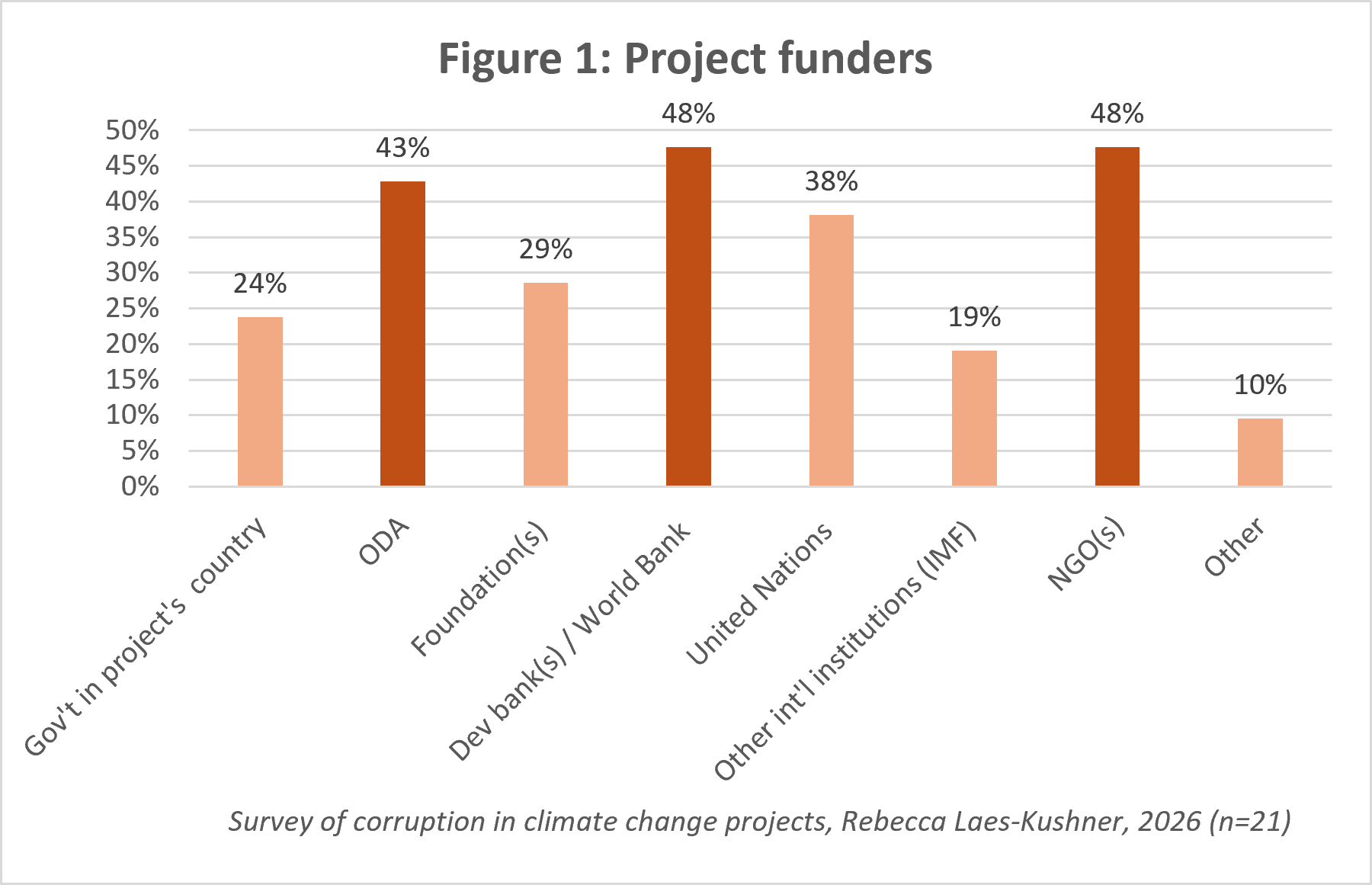
Funders’ philosophies and systems deeply influence project design, oversight and the response to reported concerns. National and local governments, NGOs, foundations, ODA and international institutions such as the World Bank and the United Nations (UN) all bear this responsibility. (see Figure 1)
-
Responding to complaints – Raising a concern does not guarantee that it will be resolved. People reporting suspected misuse need an accessible process and information about the response, with protection for their identities.
Barret: The Kenyan experience of public opposition to international lending raises a practical question: how do funders show that they have considered concerns about misuse of public money?
In April 2021, Kenyans publicly challenged continued lending to their government. A petition launched in April 2021 called on the IMF to suspend disbursement of a KSh255 billion loan package until proper accountability mechanisms were in place, citing concerns about corruption and misuse of previous loans. Kenyans also flooded an IMF Facebook live broadcast with “stop loaning Kenya” comments.
The IMF’s subsequent program-review report acknowledged public concerns about debt vulnerabilities and corruption risks relating to the use of its resources. The issue was therefore publicly raised and acknowledged. The accountability question is how such concerns influence oversight, corrective action and subsequent funding decisions.
Part 3 of this series provides guidance and inspiration for funders, donors, NGOs and governments involved in climate change projects who want to take concrete steps to reduce corruption in their projects. We look at several exemplary organizations and share lessons from both literature and the key informant interviews regarding potential solutions.
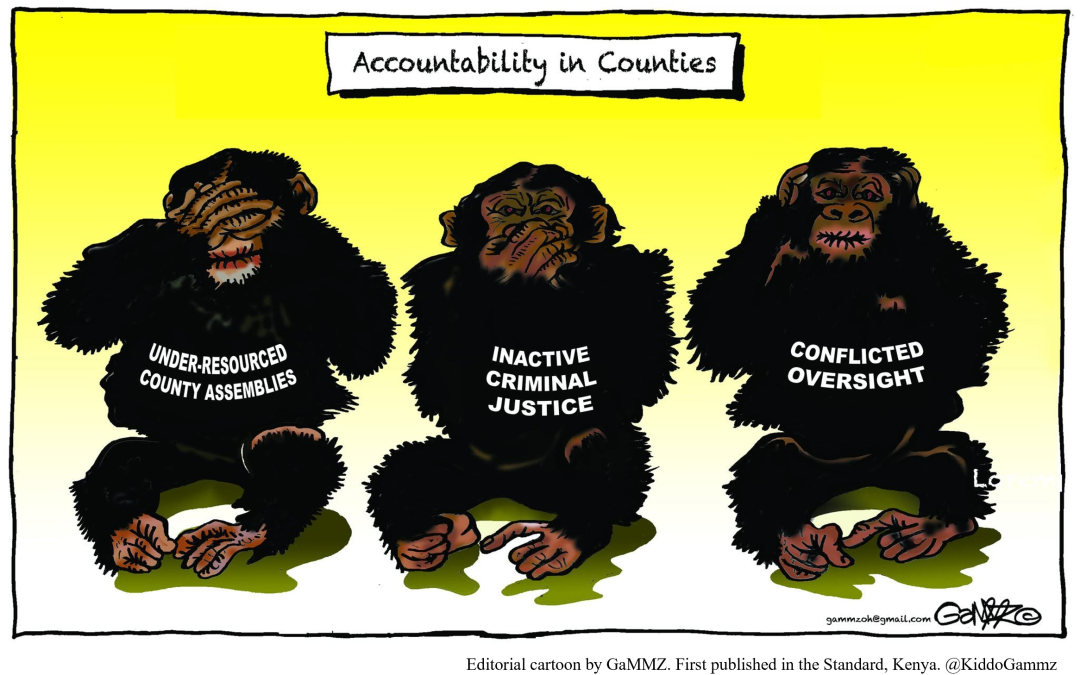
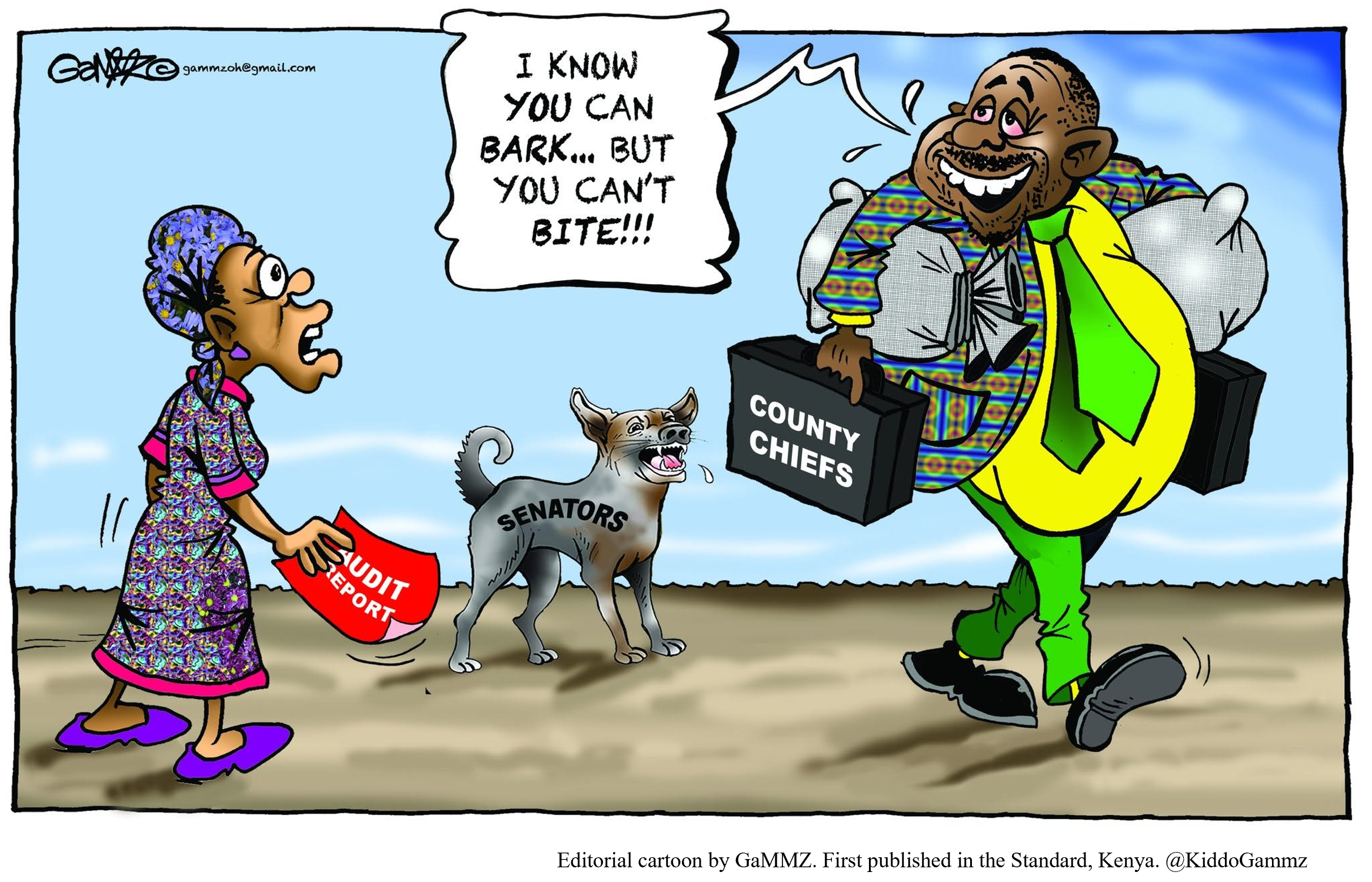
Editorial cartoons by GaMMZ. First published in the Standard, Kenya. https://x.com/kiddoGAMMZ