
Challenges in scaling agroecology and practical pathways forward
Rebecca Laes-Kushner and Harriet Keturah
Traditional agriculture has brought about huge increases in food availability in the past century. But it also relies on pesticides and herbicides, focuses on only a few key crops and is not well adapted to climate change.
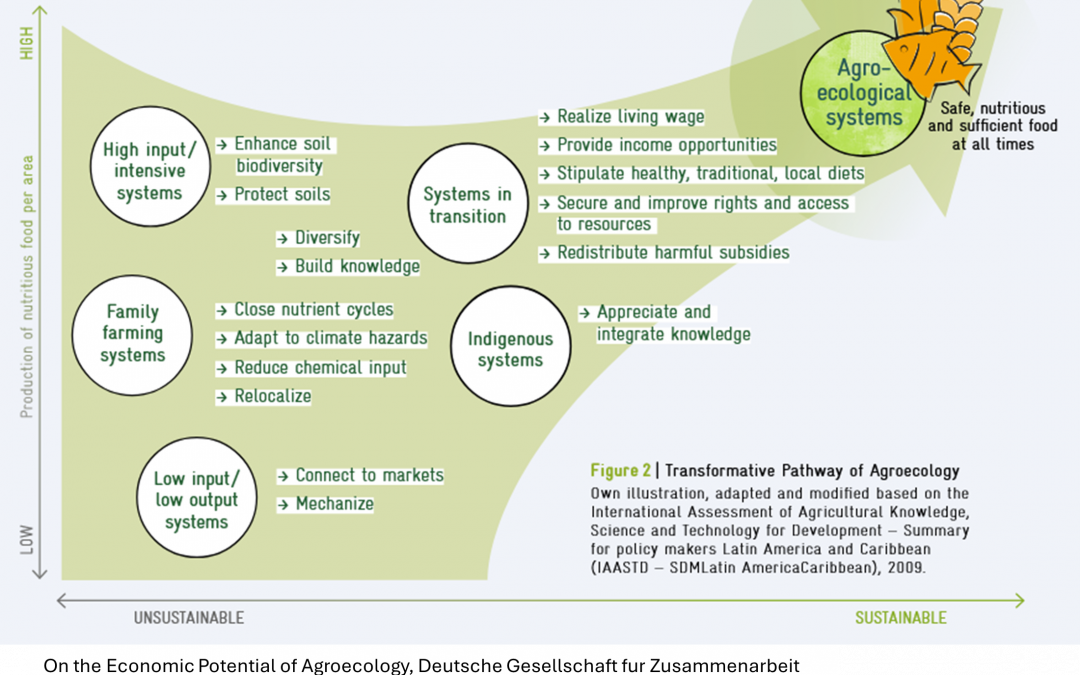
In response, agroecology has emerged as an approach that take a holistic view of farming. This approach encompasses farming techniques which sustain and nurture the soil and increase biodiversity, improved food systems via diverse diets, combining traditional knowledge with modern farming tools and providing living wages and more jobs to reduce rural poverty.
The benefits of agroecology have been proven in many anecdotal reports and case studies, which highlight increased crop yields (economic improvements), better inclusion of women and youth, the empowerment of smallholder farmers, better health due to improved diets (sociological improvements) and more biodiversity and resilience to climate change (environmental benefits).
Common agroecology techniques
- Integrated soil fertility management – a set of agricultural practices that seeks to improve agricultural productivity by increasing soil nutrients and improving crop water use. These practices are adapted to the local context, but can include:
-organic fertilizers such as compost and green manure
-use of lime and biochar
-use of intercropping, agroforestry and crop rotation - Intercropping – planting two or more complementary crops together on one plot to increase farm yields, improve soil, improve plant resilience to pests and control weeds.
For example, undersowing clover beneath grain crops reduces weeds and fixes nitrogen. Some Native American tribes have traditionally planted squash, corn and beans together; the big leaves of the squash shade the soil and retain moisture as well as inhibit weeds, while the corn provides a climbing structure for the beans and the beans fix nitrogen in the soil, which helps the other two crops grow.
- Agroforestry – a version of intercropping that involves growing both trees and crops together. This can involve planting crops between trees on cocoa, palm oil or coffee plantations, adding trees as windbreaks to fields, or planting trees to fields to provide shade, prevent soil erosion and reduce water evaporation.
The realities of agroecology
Agroecology faces a stubborn reality: it’s much easier to show success than it is to scale.
For many smallholder farmers, the biggest barrier isn’t ideology, it’s risk. Conventional farming, with all its flaws, offers predictable routines and relatively stable short-term yields. Switching to agroecology usually involves a transition period where yields can temporarily decline as soils regenerate and labor demands increase due to practices like composting, intercropping, and manual weed control. Without income buffers, savings, or access to credit, many farmers simply cannot absorb this short-term shock.
Implementation of agroecology projects is hampered by the fact that there is not common definition for the term. For some, agroecology is about specific farming practices such as intercropping, composting and reducing chemical inputs. For others, it’s a science rooted in ecology. And for yet others, it’s a broader movement about food systems, equity, and farmer empowerment. These different interpretations can create confusion when policymakers, researchers, NGOs, and farmers need to align efforts, measure progress, or design coherent support systems.
Agroecology isn’t a one-size-fits-all package you can distribute in a bag. It’s deeply contextual, built on understanding soils, ecosystems, and local practices. That makes it powerful but also harder to teach and scale.
Layered onto this definitional diversity are the challenges around capacity development. Agroecology isn’t a one-size-fits-all package that stakeholders can easily follow. It’s deeply contextual, built on understanding soils, ecosystems, and local practices. That makes it powerful but also harder to teach and scale. For example, practices like agroforestry or intercropping can be highly effective in semi-humid regions, but may require significant adaptation in arid or highly degraded landscapes, making it difficult to promote standardized recommendations across regions.
Agricultural extension systems (which provide training, advisory services, and technical support to farmers) are often overstretched and still largely geared toward promoting conventional inputs such as synthetic fertilizers and hybrid seeds rather than supporting agroecological practices.
Finances add further barriers to the adoption of agroecological practices, which can demand more time, more labor, and sometimes upfront investment. For example, establishing compost systems, planting trees for agroforestry, or transitioning away from synthetic inputs can require initial capital and delayed returns. However, most farmers lack access to financial tools designed for this transition, such as microcredit without collateral, seasonal loans aligned with diversified cropping systems, or microinsurance to buffer against climate shocks. At the same time, markets rarely reward these efforts without certification or differentiated value chains, agroecological produce is often sold at the same price as conventionally grown crops.
And hovering over all this is policy. In many countries, the system is quietly stacked against agroecology. Subsidies favor synthetic fertilizers and improved (often hybrid or high-yielding) seed varieties, while agroecological approaches receive far less support.
Add climate change to the mix – erratic rains, floods, prolonged droughts – and the challenge deepens. Ironically, agroecology is part of the solution to climate resilience, but getting there requires farmers to survive the shocks happening right now.
Scaling agroecology
So, what would it take to truly scale agroecology?
First, we need clarity. Not a rigid, one-size definition but a shared understanding of core principles. Creating common frameworks while allowing local adaptation can help align actors without losing flexibility.
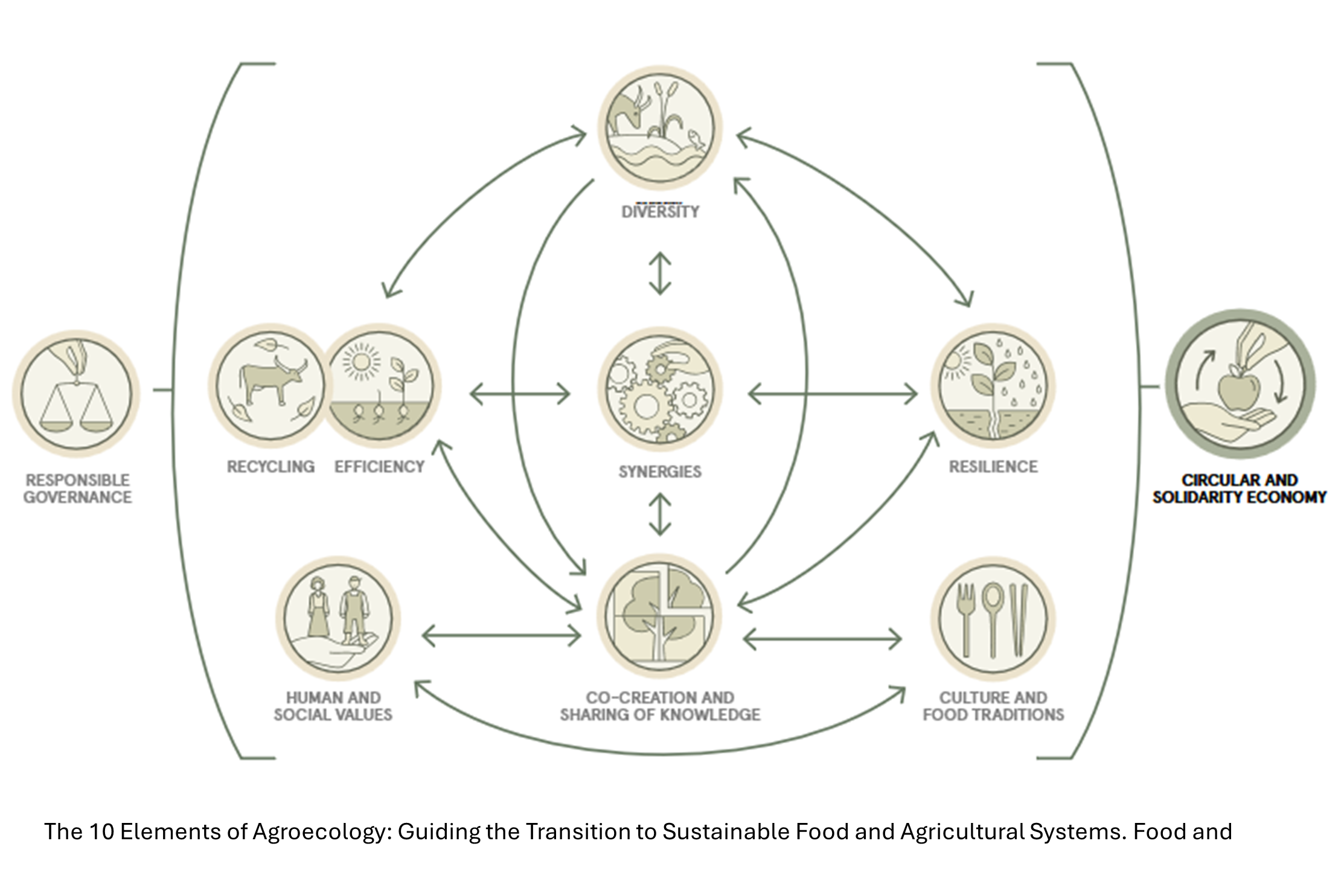
Several frameworks are already shaping how agroecology is understood and implemented. For example, the FAO’s 10 Elements of Agroecology provide a widely used structure, emphasizing principles such as diversity, co-creation of knowledge, and circular economies. While useful for alignment, they can be broad and require translation into actionable strategies at country level.
Similarly, the HLPE (High Level Panel of Experts) framework on agroecology offers a more policy-oriented lens, linking agroecology to food systems transformation and governance. Its strength lies in its systemic perspective, though it can be less accessible for field-level implementation without further simplification.
Second, we need to make the transition less risky. That means real support, including targeted subsidies, transition financing, and insurance that actually understands diversified farming systems.
Third, knowledge has to flow differently. Agroecology spreads best farmer-to-farmer, field-to-field, not top-down. Investing in participatory extension, local champions, and practical learning spaces can turn agroecology from a concept into a lived reality.
Fourth, markets must start working for farmers, not against them. Stronger value chains, credible certification (even at local levels), and growing consumer awareness can ensure farmers are rewarded for producing in ways that benefit people and the planet.
Insuring farmers
Farmers need insurance. But while traditional insurance works for larger farms, constraints limit its effectiveness in smallholder farms. Expense ratios in traditional agriculture #microinsurance often exceed 40–50% and agent commissions range from 10–15%. Add in the challenges of manual enrollment, field inspections, and administrative #overhead and costs rise further. In some cases, inspection expenses exceed the value of the claim itself.
A different model is #parametric (index-based) microinsurance, which insures against #climate events. Farmers automatically receive a payout when predefined #thresholds, such as #temperatures or #rainfall levels, are exceeded.
This model removes the administrative costs and speeds payments.
Farmers enroll digitally or through aggregator agents, with #geolocation linking their farms to specific weather grids. Insurers monitor satellite data or #weather station feeds in real time. Payments are made to the farmer’s mobile wallet. No individual loss assessment is required.
Fifth, policy needs a reset. If governments are serious about sustainability, then agroecology cannot remain on the margins. It must be embedded in national strategies, backed by incentives, and supported through long-term investment.
And finally, we need to connect the dots across the entire food system. From what farmers grow to what consumers choose, scaling agroecology isn’t just an agricultural shift it’s a societal one.
Agroecology isn’t struggling because it doesn’t work. It’s struggling because its varied definitions and context-based requirements mean systems aren’t aligned with the movement.